What I’d Do Differently: F1 Travel Edition
Updated April 2026 | 10 min read
- Eight Races. Eight Countries. A Lot of Lessons.
- 1. Book Everything the Moment the Calendar Drops
- 2. General Admission Is Fine at Some Circuits (and Terrible at Others)
- 3. Do Not Drive to the Circuit
- 4. Pack for the Weather You Do Not Want
- 5. Bring Your Own Food (or at Least Snacks)
- 6. Build a Real Trip Around the Race
- 7. Your First Race Should Be Monza or Spa
- 8. Buy Ear Protection Before You Go
- 9. Go on Friday
- 10. Do Not Buy Merch at the Circuit
- 11. Bring a Battery Pack and Treat Your Phone Like a Camera
- 12. Get Travel Insurance for International Races
- If You Can Only Go to One Race
- Travel Tools We Actually Use
- Book Tours and Activities
- Gear That Makes Race Weekends Better
- Gear That Makes Race Weekends Better
- Find Your Next Flight
Eight Races. Eight Countries. A Lot of Lessons.
Over the past few years, I have been to eight Formula 1 races: Monza, Interlagos, Barcelona, Spa-Francorchamps, Zandvoort, Mexico City, Miami, and Austria. Every single one was incredible. Every single one also involved at least one moment where I turned to Jad and said, “We should have done this differently.”
F1 travel is its own animal. It is not like booking a normal vacation. The logistics are stranger, the crowds are denser, the prices are more volatile, and the weather can wreck your whole day in ways you did not plan for. I have made enough mistakes across eight Grand Prix weekends to save you from repeating them.
Here are the lessons, in no particular order of pain.
1. Book Everything the Moment the Calendar Drops
We learned this the hard way at Zandvoort. We waited about six weeks after the F1 calendar was announced to start looking at hotels. By that point, every decent hotel in Amsterdam was either sold out or triple the normal rate. We ended up paying over $300 a night for a place that would normally run $120.
The F1 calendar usually comes out in the fall for the following season. The day it drops, book your hotels. Use flexible cancellation rates so you can adjust later, but lock something in immediately. The same goes for flights. Airlines know exactly when a Grand Prix is happening, and they price accordingly once demand builds.
For tickets, the official F1 site and circuit-specific vendors open sales months in advance. Popular races like Monza and Zandvoort sell out fast, especially grandstand seats. General admission can linger longer, but do not count on it.
2. General Admission Is Fine at Some Circuits (and Terrible at Others)
At Spa, general admission was genuinely great. The elevation changes mean you can find hillside spots with views of multiple corners. We could see cars coming through Eau Rouge and then walk to another spot for the Bus Stop chicane. For the price difference, GA at Spa is a no-brainer.
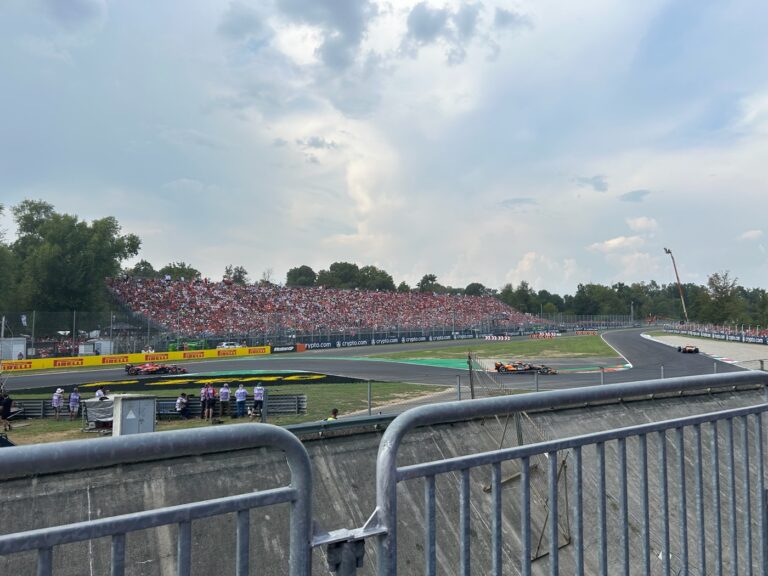
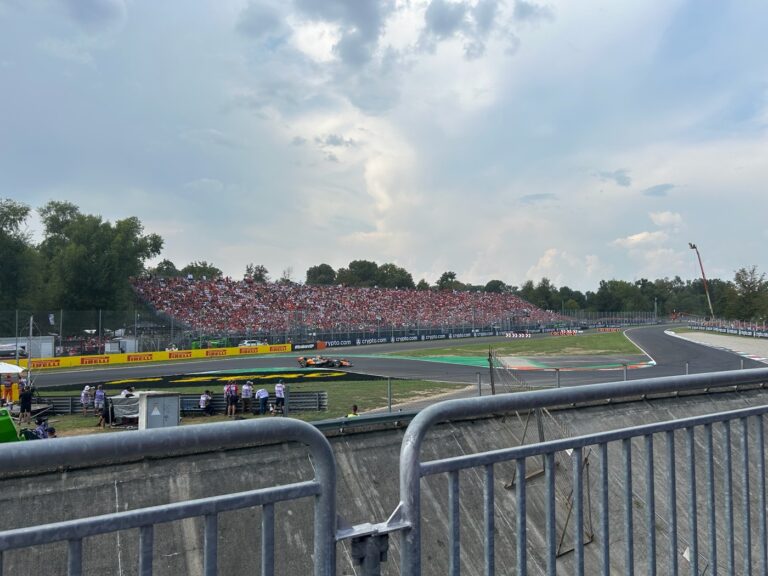
At Monza, general admission was a different story. The circuit is flat. Trees block sightlines. If you do not get to your spot early, you are standing behind five rows of people and watching the race on your phone. We did GA at Monza once and bought grandstand tickets every time after.
Barcelona is somewhere in the middle. The GA areas around the final sector are decent, but the main straight and Turn 1 are grandstand-only experiences. At Interlagos, the steep natural terrain makes GA workable if you arrive at the gates early.
My rule: if the circuit has elevation changes, GA can work. If it is flat, pay for a grandstand.
3. Do Not Drive to the Circuit
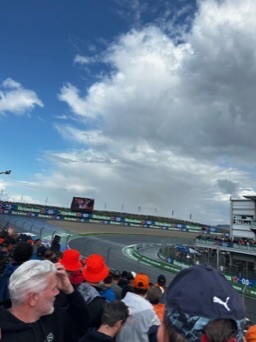
We drove to Zandvoort. I am still recovering from the parking situation. The roads into the town are narrow, the race-day traffic management funnels everyone into the same bottleneck, and we sat in the car for over an hour after the race just trying to get out of the lot.
At Monza, we took the train from Milan. It was packed, but we were at the circuit in 40 minutes and back at our hotel within an hour of the checkered flag. At Interlagos, we used the metro to Autódromo station and walked from there.
The general principle: if there is public transit or an official shuttle, use it. If you must drive, leave absurdly early and accept that you will be sitting in traffic for a long time after the race. Some circuits offer park-and-ride lots outside the immediate area, and those are usually the least painful option.
4. Pack for the Weather You Do Not Want
Spa-Francorchamps sits in the Ardennes forest in Belgium. The weather there is famously unpredictable. We went in late July and it rained sideways for most of Saturday qualifying. I had a light jacket. I needed full waterproof gear, waterproof shoes, and a dry bag for my phone and wallet.
Baku was the opposite problem. The street circuit runs along the Caspian Sea waterfront in June, and the sun is relentless. We did not bring enough sunscreen and I got burned through my shirt.
My packing list now always includes: a packable rain jacket, sunscreen regardless of forecast, a hat or cap, and a thin layer for evening sessions. Circuits are outdoor venues where you are exposed for eight-plus hours. Plan for the worst version of the forecast, not the best.
5. Bring Your Own Food (or at Least Snacks)
Circuit food is expensive and often mediocre. At Monza, a basic sandwich and a water ran about 18 euros. At Zandvoort, the lines for food vendors were 30-plus minutes during the lunch break between sessions. We missed the start of a support race because we were waiting for fries.
Now we bring a small backpack with sandwiches, protein bars, nuts, and a refillable water bottle. Most circuits allow outside food as long as you do not bring glass bottles or alcohol. Check the specific circuit’s bag policy before you go, but I have never had an issue bringing a packed lunch in a clear or mesh bag.
If you want to try circuit food, do it during a practice session when lines are short. Not during the race. Not during qualifying.
6. Build a Real Trip Around the Race
Our first race was Baku and we flew in Friday morning, did the race weekend, and flew out Monday. We saw almost nothing of Azerbaijan outside the circuit and the hotel. It was a waste of a very long flight.
After that, we started building actual trips around race weekends. Monza became a week in northern Italy. Spa became a few days in Brussels and then Amsterdam. Interlagos was part of a longer Brazil trip. Barcelona was an excuse to spend time on the coast.
F1 races happen on some of the most interesting countries in the world. Treat the race as the anchor event, not the entire trip. You are already paying for the flight. Add three or four days on either side and actually see the place.
7. Your First Race Should Be Monza or Spa
People always ask me which race they should go to first. My answer depends on what you want, but for most people, I recommend Monza or Spa.
Monza has the best atmosphere of any race I have been to. The Tifosi are unmatched. The energy after the race, especially if Ferrari does well, is something you will not experience anywhere else in motorsport. The circuit is also easy to get to from Milan, and Milan is a great city to pair with it.
Spa is the best circuit for watching racing. The track is fast, dramatic, and the layout lets you see more of the action than most venues, especially from GA. Belgium is easy to travel around and you can combine it with Brussels, Bruges, or hop over to Amsterdam.
Baku and Interlagos are both incredible but logistically more demanding. Barcelona is fun but not as distinct. Zandvoort is a party but the circuit is tight and hard to see from many angles. Save those for race two or three.
8. Buy Ear Protection Before You Go
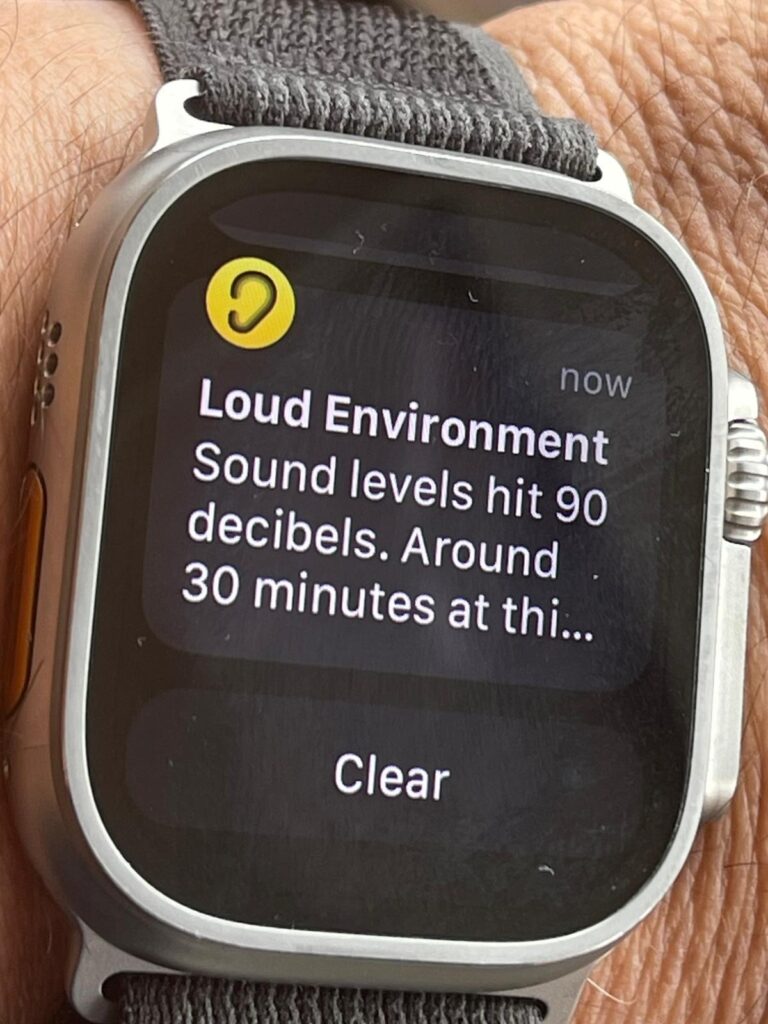
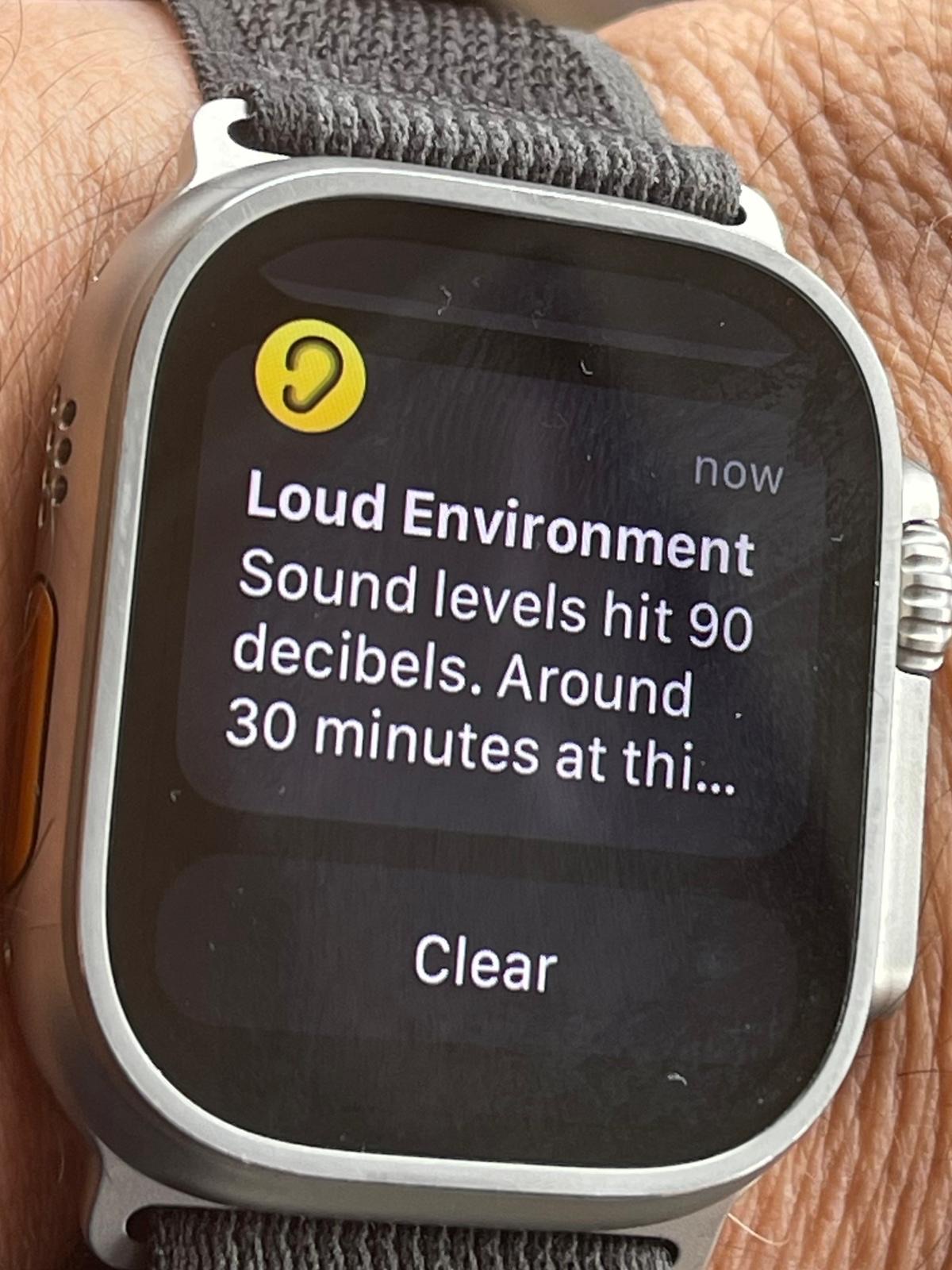
F1 cars are quieter than they used to be, but the support races are not. Formula 2, Formula 3, and Porsche Supercup cars are loud. Standing near the end of a straight during an F2 session without ear protection is genuinely painful.
We forgot ear plugs at Monza and ended up buying overpriced foam ones from a vendor inside the circuit. They were terrible. Now I bring proper reusable ear plugs rated for concerts and motorsport. They cut the harmful volume without making everything sound muffled.
If you are bringing kids, get them proper ear defenders, the over-ear kind. This is not optional.
9. Go on Friday
Friday practice sessions are the most underrated part of a Grand Prix weekend. The crowds are a fraction of Saturday and Sunday. You can move freely around the circuit, try different viewing spots, and figure out where you want to be for qualifying and the race. Food lines are short. Merch tents are browsable. The whole atmosphere is more relaxed.
At Spa, we spent Friday walking the entire circuit perimeter, watching from five or six different spots, and settled on our favorite for the rest of the weekend. At Interlagos, Friday was the day we got our best photos because we could get close to the fences without being shoulder-to-shoulder with other fans.
Three-day tickets are usually only slightly more expensive than a Saturday-Sunday combo. Friday is worth it.
10. Do Not Buy Merch at the Circuit
Team merch at the circuit is full price and the lines are long. At Zandvoort, the Red Bull tent had a 45-minute wait just to get inside. At Monza, Ferrari merch was marked up beyond what the official Ferrari store in Milan was charging.
My strategy now: browse at the circuit on Friday to see what is available, then buy online after the race or at an airport duty-free shop on the way home. The official F1 store ships internationally and runs sales after the season. Team stores do the same. The only exception is circuit-specific or race-edition merch that genuinely will not be available anywhere else, and even then, hit the merch tent first thing Friday morning before the crowds build.
11. Bring a Battery Pack and Treat Your Phone Like a Camera
A Grand Prix day runs from gates opening around 9 AM to well after the podium ceremony. That is eight to ten hours of heavy phone use: photos, videos, checking timing screens on the F1 app, messaging your group, mapping your way around the circuit, and potentially using mobile tickets.
My phone died at Baku during the race. I had no ticket on my phone for re-entry, no way to coordinate with Jad, and no photos of the podium. I now carry a 20,000mAh battery pack and a short charging cable in my bag at every race. Non-negotiable.
Also, the F1 app with live timing is worth having open during sessions. It tells you things the screens around the circuit cannot, like tire strategies and gaps between cars. But it eats battery, so plan accordingly.
12. Get Travel Insurance for International Races
This is boring advice but I am including it because we almost learned the hard way in Brazil. A friend in our group had a flight cancellation that cascaded into missing the race entirely. No insurance, no refund on the race tickets, no refund on the hotel that had a strict cancellation policy because it was race weekend.
F1 race tickets are expensive. Hotels during race weekends are expensive. Flights to places like Baku and Sao Paulo are expensive. A good travel insurance policy that covers trip interruption, event cancellation, and medical emergencies is a small price relative to the total cost of the trip. We use an annual multi-trip policy now since we travel enough to justify it.
If You Can Only Go to One Race
Go to Monza. The Italian Grand Prix has the best combination of atmosphere, accessibility, and trip potential. Fly into Milan, take the train to the circuit, spend the rest of the week eating your way through northern Italy. The Tifosi energy is unlike any sporting event I have ever attended. And if Ferrari wins, the post-race scene on the main straight is pure chaos in the best possible way.
Spa is a very close second if you care more about the racing itself than the atmosphere. But for a first-timer who wants the full experience, Monza is the answer.
Travel Tools We Actually Use
F1 weekends mean 12+ hours at a circuit with no outlets, unreliable cell service from 100,000 people overloading towers, and weather that changes between qualifying and the race.
- eSIM Data: Airalo Europe eSIM — Cell towers get hammered at circuits. An eSIM with a European data plan helps, but honestly, download the F1 TV app content offline as backup.
- Car Rental: Compare car rental prices — Some circuits are only reachable by car (Spa, Red Bull Ring). Book months early — prices triple race week.
- Travel Insurance: — International races mean international medical costs if something goes wrong. Also covers trip cancellation if a race gets rescheduled.
- VPN: — Access F1 TV and your home streaming services from any country. Some circuits block certain apps on their wifi.
- Portable Radio: Race commentary is broadcast on local FM frequencies at most circuits. Without it, you watch cars fly past with zero context. A small FM radio transforms the experience.
Book Tours and Activities
Gear That Makes Race Weekends Better
After six races, these are the items I always bring and always use:
Anker 20,000mAh Power Bank — Keeps two phones charged all day. Light enough to carry in a small bag without noticing it. I have used this at every single race since Monza.
Etymotic High-Fidelity Ear Plugs — These reduce volume evenly so everything still sounds clear, just quieter. Way better than foam plugs. I use the same pair at concerts.
Marmot PreCip Packable Rain Jacket — Folds down to the size of a water bottle. Saved me at Spa and has been in my race bag ever since. Breathable enough that you do not overheat when the sun comes back out.
Osprey Daylite Sling Bag — Big enough for a battery pack, snacks, sunscreen, rain jacket, and ear plugs. Small enough to not be annoying in a packed grandstand. Clear bag policies vary by circuit, but this has passed every check I have been through.
Gear That Makes Race Weekends Better
- 3M Peltor Ear Protection – F1 cars are painfully loud. Non-negotiable.
- Anker Nano Power Bank – 12+ hours at a circuit with no outlets.
- Osprey Farpoint 40 – Comfortable for carrying supplies all day.
- Airalo eSIM – Data at European circuits without roaming charges.
- Collapsible Water Bottle – Security won’t let full bottles through.
- Poncho (Pack of 5) – Rain at Spa is guaranteed. Be prepared everywhere.
Find Your Next Flight
Book Tours: GetYourGuide F1 Grand Prix tour packages and pit lane experiences | GetYourGuide guided circuit tours at Monza, Spa, and Barcelona
Affiliate disclosure: This post contains affiliate links. I earn a small commission if you book through them, at no extra cost to you. Links: SafetyWing travel insurance (10% off), Skyscanner for flights, Airalo eSIM for data, GetYourGuide for tours, Booking.com for hotels, Viator for tours.
Real costs, honest reviews, and what I’d do differently — straight to your inbox.
Plan your own trip: guides I actually use
More from this region:
- Monza Grand Prix: The Complete Travel Guide for First-Timers
- Cheapest F1 Races for Americans: Ranked by Total Trip Cost
- Spa-Francorchamps Rain Gear Guide: What to Pack
- Monza Grand Prix Packing Guide: What Actually Works
- The Real Grand Prix Kit: What to Pack for F1
Cards, lounges & insurance:
- Best Airport Lounges I Have Actually Used — From Changi to Istanbul
- Is Priority Pass Worth It in 2026 — My Honest Review After 15 Airports
- Best Travel Credit Cards for 2026: The Cards I Actually Use and Why
- Best Travel Insurance for 2026: What I Actually Recommend After 15 International Trips
Finding cheap flights:
- Going vs Dollar Flight Club vs Thrifty Traveler: Which Flight Deal Service Is Worth It in 2026?
- When to Book Flights by Region — The Booking Windows That Actually Save Money
- How to Find Error Fares and Flight Deals — The Services I Actually Use
- Google Flights vs Skyscanner vs Momondo — Which Actually Finds the Cheapest Flights
Staying connected abroad:
- Best VPN for Travel 2026 — NordVPN vs Surfshark and Why You Need One
- Best eSIM for Travel 2026 — Holafly vs Airalo vs Nomad
Travel gear I actually use:
- Best Portable Chargers for Travel in 2026: Which Size You Actually Need
- My Exact Travel Tech Setup After 15 International Trips
- Best Noise-Canceling Headphones for Travel in 2026: Tested on 40+ Flights
- Best Travel Backpacks for 2026: The 5 I Have Actually Used
Written by Jenna Fattah
I have visited 25+ countries across 6 continents, attended 7 Formula 1 races, and spent 4 years writing about what actually works and what I would do differently. Every recommendation on this site comes from trips I planned and paid for myself. Read more about me