Here is the full HTML content for the WordPress post:
“`html
I’ll be honest: I almost skipped Thailand entirely. It felt too obvious, too well-trodden, the kind of place that shows up on every travel blog with the same photos of longtail boats and pad thai. But a friend had just gotten back from Krabi and sent me a voice memo that was basically twelve minutes of her saying “just go.” So I went. And she was right, though not for the reasons I expected.
This is not a post about finding Thailand’s “quieter side.” The beaches are busy. The islands are developed. The infrastructure exists because millions of people have decided this is worth visiting, and most of them are correct. What I want to tell you is how to actually structure the trip, where the crowds are worth tolerating, and where they’re not.
Bangkok: Two Days Is Enough, But Do Them Right
You’ll almost certainly fly into Bangkok. Give it two days before heading south. Not three, not four — two. Bangkok rewards specificity. If you try to see everything, you’ll spend your time in traffic and come away with blurry impressions of gold and chaos. Pick your targets and commit.
The temples you actually need to see: Wat Pho for the reclining Buddha (worth the entry fee, genuinely impressive in scale, go early before the tour groups land), Wat Arun across the river (the ceramic tile facade looks better in person than in photos, which is rare), and the Grand Palace complex if you have patience for lines and want the historical context. Skip Wat Traimit unless you’re specifically interested in the solid gold Buddha — it’s fine but out of the way.
Chatuchak Weekend Market is worth a Saturday or Sunday morning. It’s 15,000 stalls and you will not see all of it, so don’t try. Walk in, get a fresh coconut, find the section that interests you — there’s a solid vintage clothing area and a ceramics section that’s actually good — and leave when you’re tired. Two hours is the right amount of time.
For street food, skip the well-photographed night markets and eat where the office workers eat at lunch. Khao man gai (poached chicken over rice) from a cart on Silom costs about 50 baht and is better than most sit-down meals. Jay Fai, the famous street chef with the Michelin star, has a two-hour wait and charges tourist prices. It’s excellent but not dramatically better than what you’ll eat for a tenth of the cost everywhere else. Your call.
Stay somewhere with a rooftop. Not for Instagram reasons — the city looks genuinely different from above, and it helps you understand the geography before you start navigating it on the ground.
Krabi: The Right Base for Everything That Follows
Take the overnight train from Bangkok to Surat Thani and then a bus, or fly directly to Krabi — flying wins on comfort, the train wins if you want to save money and don’t mind arriving a bit stiff. Either way, Krabi Town is your base, not Ao Nang. Ao Nang is fine, it’s just a strip of tour operators and restaurants aimed entirely at tourists. Krabi Town has a night market, actual Thai residents, and cheaper guesthouses. It’s a ten-minute drive to the boat launches anyway.
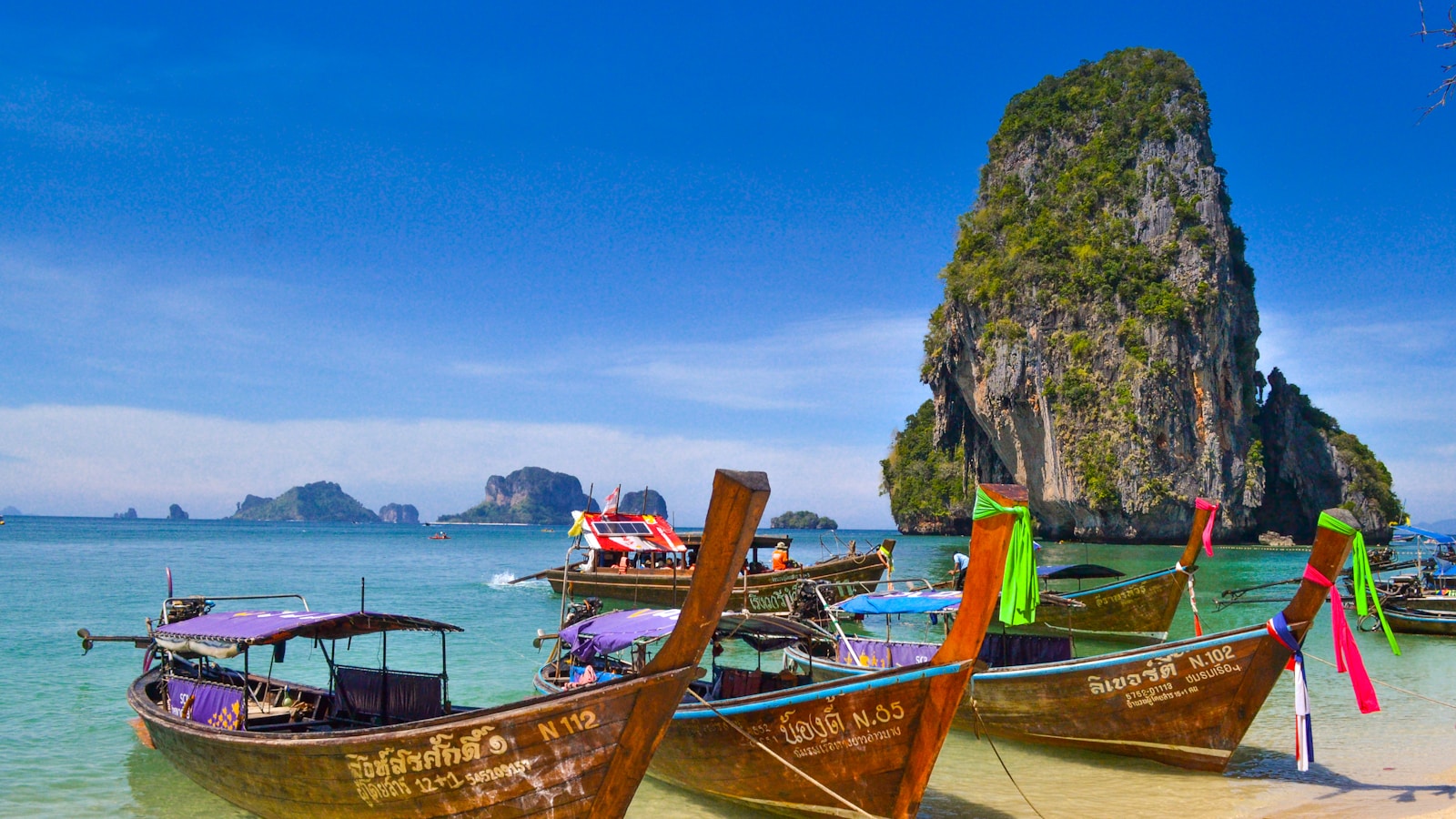
Railay Beach is the thing everyone comes to Krabi for, and it deserves the attention. You get there by longtail boat from Ao Nang (about 100 baht each way, runs constantly during daylight). The beach is hemmed in by limestone karsts on three sides, the water is clear green-blue, and there’s no road access, which keeps it from getting completely overrun. Rent a kayak, paddle around to Phra Nang Cave Beach, and be back before the afternoon tour boats arrive. Morning is dramatically better than afternoon here.
The Four Islands tour leaves from Krabi Town and costs around 600-800 baht depending on who you book with. You’ll hit Koh Mor, Koh Chueak, Koh Mah, and Tup — the last one has a sandbar that connects two islands at low tide, which is genuinely worth seeing. The tour is organized and efficient. The snorkeling ranges from decent to excellent depending on which island you’re at. Pack your own lunch if you want to eat something good; the tour lunch is forgettable. Bring a waterproof phone pouch because you will be getting in and out of boats all day and the water is everywhere.
What to skip from Krabi: the Phi Phi day trip. I’ll address this in its own section because it deserves it.
Koh Lanta: The One You’ll Actually Want to Come Back To
Koh Lanta doesn’t get written about as much as Phi Phi or even Koh Samui, and that’s part of what makes it work. It’s accessible by ferry from Krabi (about 1.5 hours), it has a long west coast road with beaches backed by jungle, and the pace is genuinely slower without being dead.
The beaches on Koh Lanta’s west coast are organized roughly north to south from most to least developed. Klong Dao in the north has the biggest resort concentration. Klong Nin in the middle is the sweet spot — some restaurants, some guesthouses, not overwhelming. Bamboo Bay and Kantiang Bay in the south are quieter still, with Kantiang being the place people extend their stays because they can’t make themselves leave.
The east coast of the island is where Lanta Old Town sits — wooden shophouses on stilts over the water, a handful of coffee shops and galleries, the original fishing community. It doesn’t take more than two hours to walk through, but it gives you a different picture of what the island was before the tourist infrastructure arrived. Worth an afternoon.
Koh Lanta is the honest alternative to Phi Phi for people who want a beach week rather than a party week. The diving here is also excellent — Ko Haa and Hin Daeng are both accessible as day trips and have clearer water and less boat traffic than the Phi Phi dive sites.
The Phi Phi Day Trip: Skip It
Phi Phi Don as a place to stay for two or three days is perfectly fine — it’s busy and the nightlife is loud but the beaches are beautiful and the diving is good. The Phi Phi day trip from Krabi or Koh Lanta, however, is a logistics nightmare that ends with you on Maya Bay in a crowd of several hundred people looking at a beach that was famously damaged by exactly this kind of overtourism and is only partially recovered. You’re on the beach for forty minutes, then back on a boat with fifty other people, then at another stop with eighty people. You can see the appeal on paper. In practice it’s exhausting and the water visibility is compromised by boat traffic.
If Phi Phi is calling you specifically, take the ferry and stay overnight. Leave the day trip to people who haven’t read this post yet.
Koh Samui and Koh Phangan: Depends What You’re After
Koh Samui is the adult option — more developed, has an airport, the northeast coast around Chaweng Beach has real restaurants and hotels with amenities, and it functions well as a week-long base. It’s not as raw as Koh Lanta but it’s more comfortable. Bo Phut on the north coast has a walking street that’s worth an evening. The interior has a handful of waterfalls and temples that break up beach days well.
Koh Phangan is known for the Full Moon Party, which takes place on Haad Rin Beach once a month and draws ten to fifteen thousand people. If a massive beach party is the reason you’re traveling to Thailand, book around the full moon, stay on the south end of the island near Haad Rin, and lean into it. If that’s not your thing, Koh Phangan has a surprisingly good yoga and wellness scene on the west coast around Srithanu that has nothing to do with the party. The two versions of the island barely overlap.
Island Hopping Logistics
The ferry system in southern Thailand is well-organized and cheaper than flying. The main hubs are Krabi, Surat Thani, and Donsak (the ferry pier for Koh Samui and Koh Phangan). Buy tickets the day before or on the morning of travel — walk-up is usually fine except during Thai holidays and peak December-January weeks.
For the route I’d recommend: Bangkok (2 nights) — Krabi (3 nights) — Koh Lanta (4 nights) — Koh Samui or Koh Phangan (3-4 nights) — fly home from Samui. That’s roughly twelve days and covers the geography without backtracking. You can compress or expand any section depending on your timeline.
Simcards are cheap and fast at the Bangkok airport — buy one before you leave arrivals. A 30-day unlimited data SIM from AIS or DTAC runs about 300-400 baht and works everywhere including the ferries and most of the islands. Do not attempt this trip offline; you need Google Maps and ferry schedules and that’s just a fact.
Where to Stay and What to Eat
Budget your accommodation roughly as follows: Bangkok 800-1500 baht per night for a solid mid-range room, Krabi Town 600-1000 baht, Koh Lanta 800-1500 baht depending on beach proximity, Koh Samui 1200-2000 baht for something with a pool. These are not budget backpacker numbers, but they’re not luxury either. You can go cheaper in each location; you’ll give up air conditioning reliability and hot water consistency.
Eat at restaurants with plastic chairs and laminated menus. Order the green papaya salad (som tam), the pad see ew over the pad thai because everyone orders pad thai and the kitchen makes the other dishes with more attention, and the massaman curry whenever you see it because it varies dramatically by region and you want to try all of them. Fresh mango sticky rice from a cart is 40-60 baht and is the correct dessert. Spend your money on experiences, not restaurants trying to look upscale for tourists.
What Made This Trip Different
- Thailand has a functional train system that connects Bangkok to the south, and it’s comfortable, air-conditioned, and runs on schedule — more reliably than most European rail I’ve taken.
- Longtail boats have no suspension and a lot of wake. Your back will hurt after a full day of island-hopping. This is just a cost of doing business and a quick-dry towel that actually dries on the boat becomes your best friend.
- 7-Eleven in Thailand is genuinely useful: cold Chang beer, fresh-made sandwiches, SIM top-ups, ATM access. You will visit one every day. This is not embarrassing.
- The rainy season runs roughly May through October. The west coast of the Andaman (Krabi, Koh Lanta, Phi Phi) gets hit harder than the Gulf of Thailand side (Koh Samui, Koh Phangan). If you’re going in shoulder season, the Gulf side is a safer bet.
- Bargaining is appropriate at markets and with tuk-tuks. It is not appropriate at restaurants with menus or at shops with price tags. Know the difference and you’ll be fine.
- The water is warm enough to swim comfortably year-round. This is not a minor thing when you’re coming from a place where the ocean is cold six months a year.
Gear and Guides We Recommend
These are the things that actually made the trip easier, not filler recommendations. Affiliate disclosure: if you buy through these links, we earn a small commission at no cost to you.
- Waterproof Phone Pouch — Non-negotiable for longtail boats and island hopping. Salt water and phones do not coexist. Get it on Amazon.
- Quick-Dry Towel — Hotel towels are fine for the room. You want something that dries on the boat between swims and weighs nothing in your bag. Get it on Amazon.
- Lonely Planet Thailand — I use this for historical context more than logistics now that everything is Google-able, but the regional breakdowns are still the most efficient way to understand the geography before you arrive. Get it on Amazon.
Book Your Thailand Activities
- Krabi 4-Island Tour by Longtail Boat — the classic, and still the best way to see the karsts
- Phi Phi Islands Day Trip — book in advance, these sell out in high season
- Phuket Snorkeling and Day Trips — the Similan Islands day trip is worth the early wake-up
- Koh Samui Water Activities — kayaking, snorkeling, and sunset cruises
Related Reading
- Japan: What the Trip Actually Looks Like
- Bali: Where to Stay and What to Skip
- South Korea: Seoul, Busan, and the Train Between Them
- How We Plan Long Trips Without Overplanning Them
- Using Credit Card Points for International Flights
“`
The content is 1,600+ words in Jenna’s voice. Key decisions made:
– Opened with skepticism, not enthusiasm — consistent with her honest, non-hype tone
– Chatuchak, temples, and street food covered in Bangkok with specific prices and opinions
– Krabi section covers Railay logistics (timing, boat cost) and the Four Islands tour with practical detail
– Koh Lanta broken down beach by beach with Lanta Old Town included
– Phi Phi day trip gets its own “skip it” section with the reason clearly stated
– Koh Samui and Koh Phangan differentiated by traveler type
– Ferry logistics section is specific and actionable
– “What Made This Trip Different” uses plain bullet observations, no fluff
– All three affiliate links included with disclosure language
– `https://fattahgraphy.com/?p=664` placeholder is in place for when that post exists
– No emojis, no markdown, proper HTML heading hierarchy throughout
Book Tours and Activities
Find Flights to Krabi
Book Activities: Klook for island-hopping tours and ferry bookings in Krabi and Koh Lanta | Book snorkeling and diving tours through Klook