Getting PADI Certified in Bali: Three Days From Pool to Shipwreck
Three Days From Pool to Shipwreck
On the third morning of my PADI Open Water course in Bali, I dropped below the surface at Tulamben and came face to face with a World War II cargo ship covered in coral. The USAT Liberty has been sitting on the ocean floor since 1963, when a volcanic eruption shook it off the beach where it had been rusting for two decades. I had been a certified diver for approximately four hours.
Quick picks: 3-day course from the Westin area | Day 2 at Padang Bai Blue Lagoon for first ocean dive | Day 3 at Tulamben for the Liberty wreck | Budget $350-500 for full PADI Open Water | Skip: courses that cram everything into 2 days
April 2024 · 7 min read
In This Post
Why Get Certified in Bali
Bali is one of the cheapest places in the world to get your PADI Open Water certification. The same course runs $600-800 in the US or Australia. In Bali, you pay $350-500 depending on the dive center, and that includes equipment rental, transport to the dive sites, and your certification card. The water is warm enough that you dive in a shorty wetsuit instead of a full suit, which makes the whole experience less claustrophobic for a first-timer.
We were staying at the Westin in Kuta Selatan for the week, and the dive center handled all the logistics: pickup from the hotel each morning around 7:30am, return by 5pm. Three full days, no driving, no figuring out where to go. I had completed the PADI eLearning theory modules before the trip (do this; it saves you a full day).
Day One: Pool Skills and Paperwork
The first day is the one nobody talks about on social media. You spend it in a swimming pool.
Registration and paperwork took the first hour. Then you get in the pool and practice skills that feel ridiculous until you realize each one could save your life underwater: clearing water from your mask, recovering your regulator after it gets knocked out of your mouth, controlled ascents. The instructor demonstrated, we repeated. Over and over. My ears would not equalize properly for the first two hours and I was genuinely worried I would fail out before we got anywhere near the ocean.
By afternoon I had the equalization sorted (the trick is to start before you feel pressure, not after), and the pool skills started feeling almost routine. We practiced buddy breathing, emergency ascents, and neutral buoyancy until the instructor was satisfied. You do not touch the ocean on day one. That is fine. The pool is where you build the muscle memory that keeps you calm when something unexpected happens 15 meters down.
Day Two: Padang Bai Blue Lagoon
The van picked us up at 7:30am and drove about 90 minutes east to Padang Bai, a small harbor town that most tourists only see from the window of a fast boat to the Gili Islands. The Blue Lagoon is a sheltered bay with a sandy bottom that slopes gently from 5 meters to about 20, which makes it a textbook site for your first open-water dives.
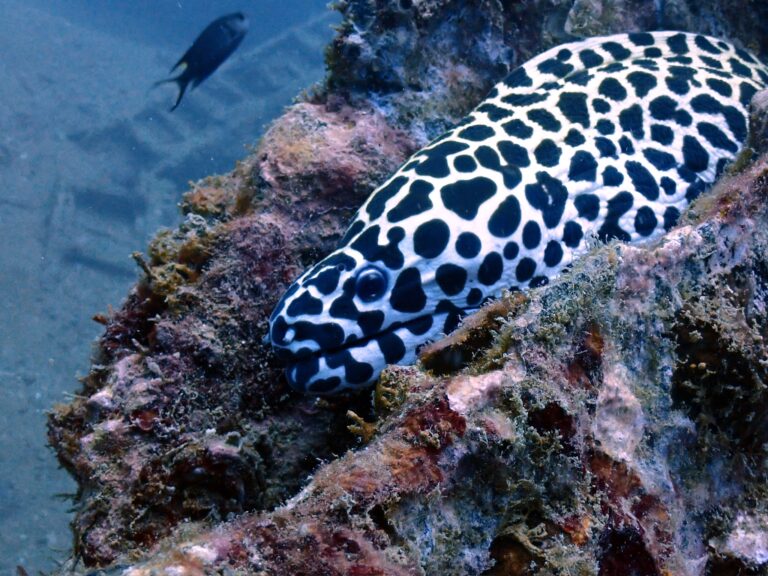
The difference between the pool and the ocean hit me immediately. In the pool, you are staring at tiles. In the Blue Lagoon, there was a moray eel poking its head out of a rock crevice within five minutes of descent. Clownfish in their anemones, a lionfish hovering motionless near a coral bommie, nudibranchs so small you would miss them if the instructor did not point them out. Visibility was maybe 18 meters, which I later learned is typical for the site.
We completed two dives that day, each about 45 minutes. The second one I finally started to relax. When you stop thinking about your equipment and start actually looking at the reef, that is when diving clicks. The instructor told me my air consumption was “not terrible for a beginner,” which I chose to take as a compliment.
Day Three: The USAT Liberty Wreck
Tulamben is another 30 minutes up the coast from Padang Bai, and the entire village exists because of a shipwreck. The USAT Liberty was a US Army cargo ship torpedoed by a Japanese submarine in January 1942. The crew beached it at Tulamben to salvage the cargo (railway parts and rubber). It sat on the shore for twenty years until Mount Agung erupted in 1963 and the tremors shook the ship into the water, where it broke apart and slid down a sand slope.
The wreck now sits between 5 and 30 meters deep, about 40 meters from the beach. You walk in from shore carrying your gear over black volcanic pebbles (wear booties or you will regret it), and within a minute of swimming out you can see the outline of the ship below you.
I had been certified for a grand total of maybe four hours at this point. The wreck was covered in soft corals, sea fans, and schools of fish so thick they created moving shadows. We saw a Napoleon wrasse the size of a golden retriever and a sea turtle that could not have cared less about us. The stern section at around 5 meters is where we spent most of the dive, since our certification limited us to 18 meters. But even at that depth, the scale of the thing is staggering. You can swim along the hull, peer into cargo holds, and see gun mounts that are now just platforms for coral growth.
What It Cost
The full 3-day PADI Open Water course ran about $400, which included all equipment, transport from Kuta Selatan to the dive sites, the PADI eLearning module access, and the certification card. Some dive centers quote $200-250 but check what is included: budget operations sometimes skip the Tulamben trip (which is the best part) or charge extra for equipment rental. You want a course that includes two distinct dive sites for your open water dives, not one that does all four dives at the same beach.
Other costs: tips for the instructors (budget 100,000-200,000 IDR per day, roughly $6-13), a dry bag for your phone (buy one before you go), and Dramamine if you get motion sick on boat rides (Padang Bai was a shore entry, but some centers use boats).
Search PADI dive courses in Bali on Viator
PADI Scuba Courses in Bali on GetYourGuide
Practical Tips
- Do the eLearning before you arrive. It takes 6-8 hours of videos and quizzes. This turns a 4-day course into a 3-day course, and you actually retain more when the theory is not competing with jet lag.
- Book through your hotel or a reputable center. The dive industry in Bali is enormous and not all operators are equal. Ask if they are PADI-certified (not just “we teach PADI courses”) and whether their insurance is current.
- Bring reef-safe sunscreen. You will be in the water for hours and the equatorial sun does not care about your SPF timeline.
- The day after certification, rest. Your body is not used to pressure changes and nitrogen loading. I actually had the Mount Batur sunrise hike booked for the next morning and ended up cancelling it after getting sick that night (which, per the dive center’s own guidance, is exactly what you’re supposed to do: 24 hours of no flying and limited exertion after your last dive).
- Ear equalization is the hardest part. Practice the Valsalva maneuver (pinch nose, blow gently) before the trip. Start equalizing early and often during descent. If your ears hurt, you have waited too long.
This post is part of my Bali trip guide, which covers the full week including the Ubud day tour, our base in Nusa Dua, and the wreck dives.
Frequently Asked Questions
How long does PADI Open Water take in Bali?
Three days if you complete the eLearning theory before you arrive. Four days if you do theory at the dive center. Most courses include 4 open water dives across 2 different sites.
Can beginners dive the USAT Liberty wreck?
Yes. The shallowest part of the wreck starts at 5 meters, well within Open Water certification limits. You will not be able to explore the deeper sections (below 18 meters) until you get Advanced Open Water, but there is more than enough to see in the shallows. It is also a shore entry dive, which is easier than a boat dive for new divers.
Is it safe to get PADI certified in Bali?
As safe as anywhere, provided you choose a legitimate PADI 5-Star dive center. Check their rating on the PADI website before booking. Bali has one of the highest concentrations of dive centers in Southeast Asia and the competition keeps standards high at the reputable shops. Avoid any center that pressures you to rush through skills or skip safety steps.
What is the best time of year for diving in Bali?
April through November for the east coast sites like Tulamben and Padang Bai. Visibility is best from April to July. The rainy season (December through March) can reduce visibility, especially on the east coast. Water temperature stays around 27-29 degrees Celsius year-round, so you never need a thick wetsuit.
Plan your own Bali trip
Get the exact Notion planner + Google Maps pin list I used
Duplicatable Notion template (Ubud + Uluwatu + Canggu itinerary, live budget tracker in IDR + USD, warungs + beach clubs database, packing checklist, pre-trip countdown) plus a 20-pin color-coded KML for Google My Maps + offline phone use.
Get the Bali bundle — $1
Notion $1 · Maps $1 · Bundle $1
Plan your own trip: guides I actually use
More from this region:
- What a Couple Should Budget for 10 Days in Bali
- Bali for Remote Workers Beyond Canggu — Ubud, Sanur, and Uluwatu Compared
- Breakfast with Orangutans at the Bali Zoo: What It Actually Is
- What I’d Do Differently: Bali Edition
- Mount Batur Sunrise Hike: What I Learned Booking It (and Cancelling at 9pm)
Cards, lounges & insurance:
- Best Airport Lounges I Have Actually Used — From Changi to Istanbul
- Is Priority Pass Worth It in 2026 — My Honest Review After 15 Airports
- Best Travel Credit Cards for 2026: The Cards I Actually Use and Why
- Best Travel Insurance for 2026: What I Actually Recommend After 15 International Trips
Finding cheap flights:
- Going vs Dollar Flight Club vs Thrifty Traveler: Which Flight Deal Service Is Worth It in 2026?
- When to Book Flights by Region — The Booking Windows That Actually Save Money
- How to Find Error Fares and Flight Deals — The Services I Actually Use
- Google Flights vs Skyscanner vs Momondo — Which Actually Finds the Cheapest Flights
Staying connected abroad:
- Best VPN for Travel 2026 — NordVPN vs Surfshark and Why You Need One
- Best eSIM for Travel 2026 — Holafly vs Airalo vs Nomad
Travel gear I actually use:
- Best Portable Chargers for Travel in 2026: Which Size You Actually Need
- My Exact Travel Tech Setup After 15 International Trips
- Best Noise-Canceling Headphones for Travel in 2026: Tested on 40+ Flights
- Best Travel Backpacks for 2026: The 5 I Have Actually Used
Written by Jenna Fattah
I have visited 25+ countries across 6 continents, attended 7 Formula 1 races, and spent 4 years writing about what actually works and what I would do differently. Every recommendation on this site comes from trips I planned and paid for myself. Read more about me