Monza Grand Prix: The Complete Travel Guide for First-Timers
Updated April 2026 | 13 min read
- Monza Grand Prix: The Complete Travel Guide for First-Timers
- Why Monza Should Be Your First European F1 Race
- Getting There: Flights, Trains, and the Last Mile
- Where to Stay: Milan vs. Monza Town
- The Circuit: Where to Watch the Race
- Race Weekend Logistics
- Combining Monza with Italy Travel
- September in Italy: Weather, Packing, Crowds
- Costs Breakdown: What You’ll Actually Spend
- What I’d Do Differently
- Gear That Makes a Difference at Monza
- Final Thoughts
- Book Tours and Activities
- Find Flights to Milan
Monza Grand Prix: The Complete Travel Guide for First-Timers
I’ve written about Monza before — the trip report and how it fit into our Italy itinerary. Those posts cover the story. This one covers the logistics. Everything I wish someone had spelled out for me before I booked the first flight.
If you’re an American F1 fan thinking about attending the Italian Grand Prix at Monza, this is the practical guide: how to get there, where to stay, what seats to pick, how much it actually costs, and what to do with the rest of your time in Italy.
Why Monza Should Be Your First European F1 Race
Monza is the easiest sell on the European F1 calendar. The circuit has been hosting Formula 1 since 1950. It sits inside a royal park on the outskirts of Milan, one of the best-connected cities in Europe. Flights from the US are frequent, affordable, and often direct. And the Italian Grand Prix carries a weight that newer races just don’t have.
But the real reason to pick Monza over Spa or Silverstone or Barcelona for your first European race is the tifosi. Italian fans treat the race like a national holiday. The energy inside the circuit builds all weekend and peaks after the checkered flag when tens of thousands of people flood onto the track. You don’t watch the Italian Grand Prix. You participate in it.
The racing itself is usually good. Monza is the fastest circuit on the calendar — long straights, heavy braking zones, low downforce setups. Cars run with their rear wings shaved down, which means slipstreaming and DRS overtakes into the first chicane. It’s not a procession track. Things happen here.
And it’s affordable. Not the cheapest race in F1, but general admission tickets start around 100 euros for the full weekend. Compare that to Zandvoort at 250+ euros or the US races at $400+. Your money goes further at Monza than almost anywhere else on the calendar.
The Race I Saw: Leclerc, the Tifosi, and a One-Stop Gamble
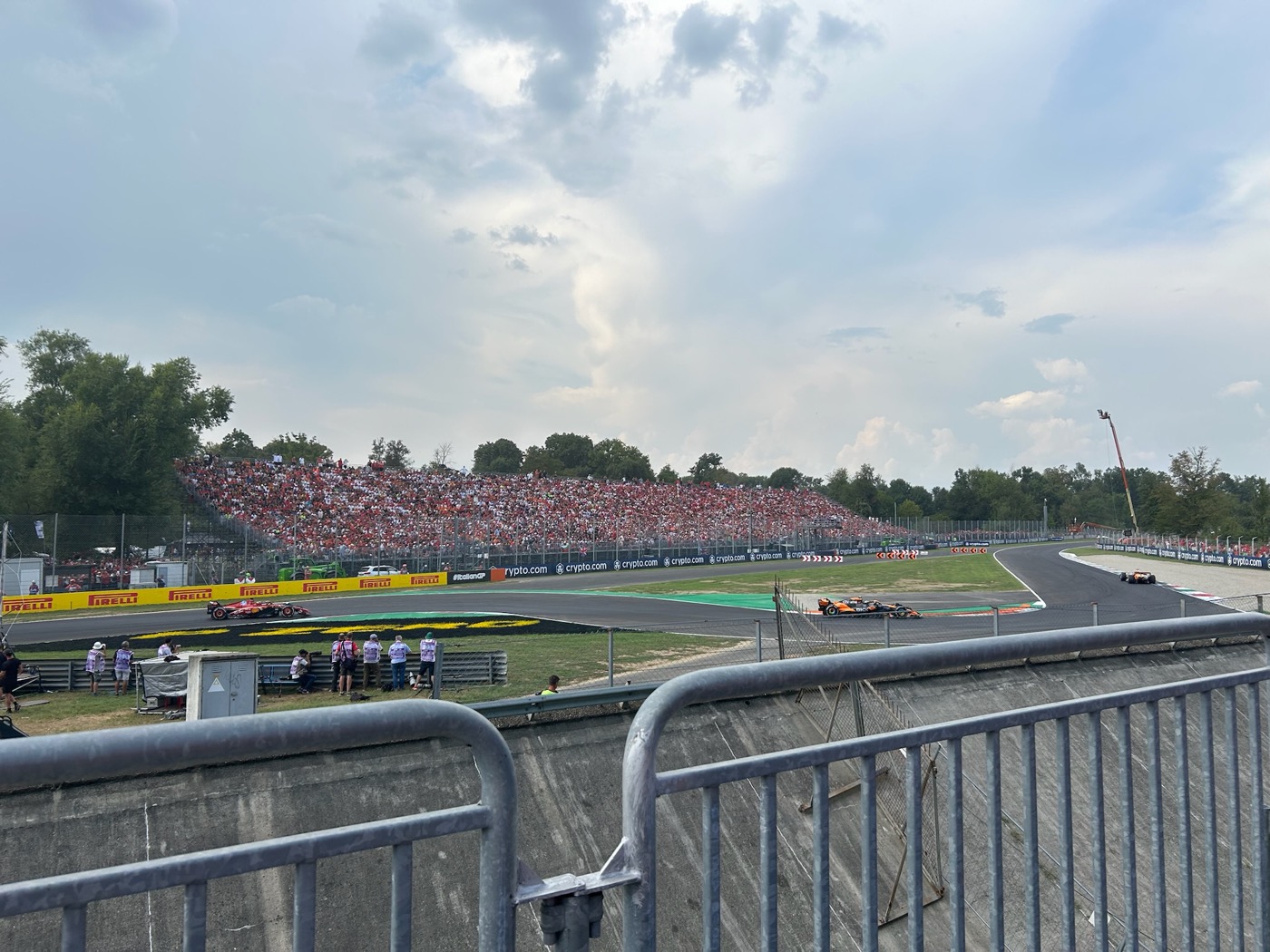
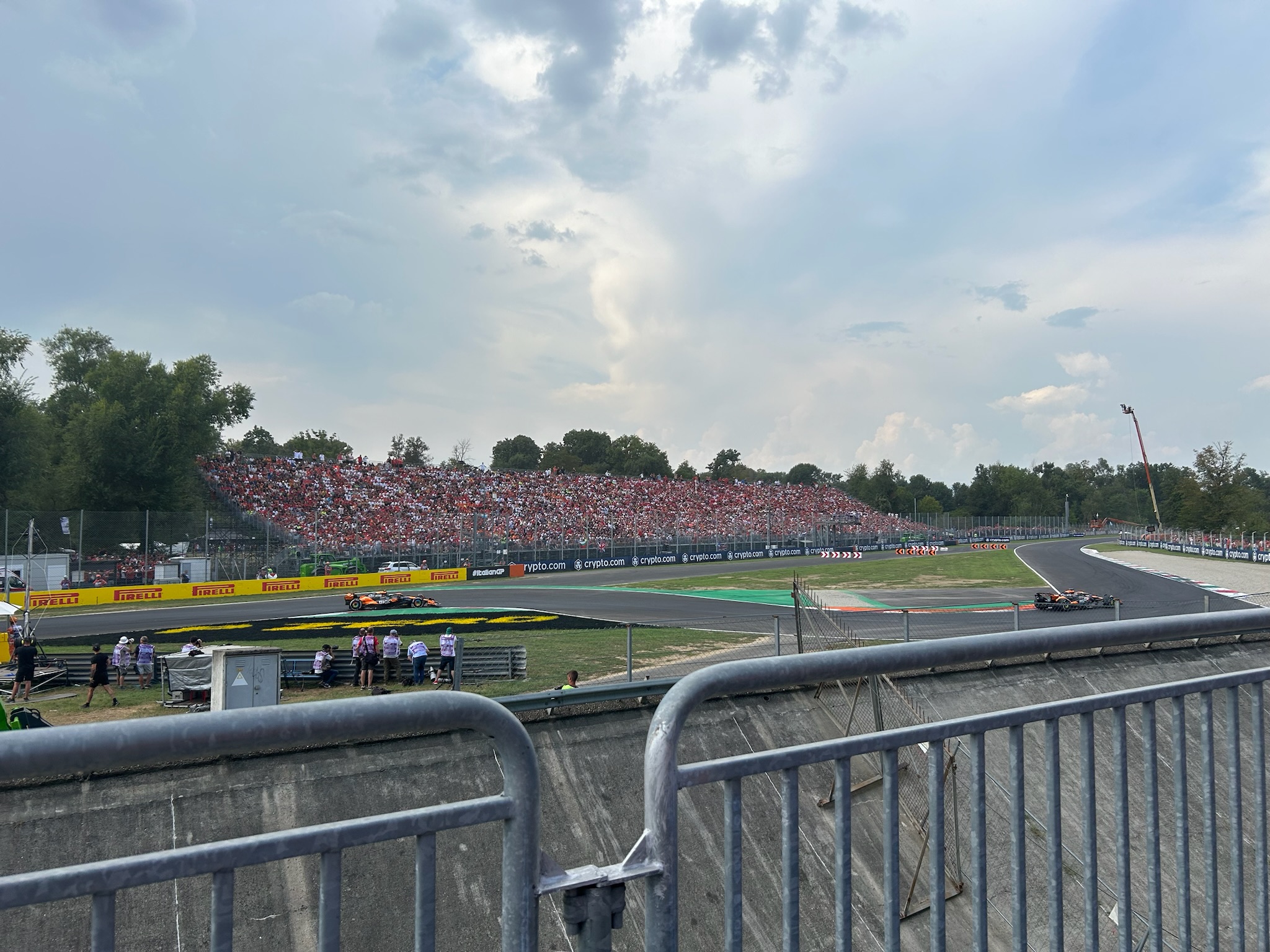
Our grandstand looked straight across the track at the main tifosi stand, which on race day is a solid wall of red. Over the Pirelli boards you catch the cars and the crowd in the same frame, and when something goes right for Ferrari the noise rolls at you from across the circuit.
2024 was the perfect year to be in that seat. Charles Leclerc gambled on a one-stop strategy and won for Ferrari at their home race, holding off Oscar Piastri by under three seconds, with Lewis Hamilton fifth. Two of my three favorite drivers near the front, a Ferrari win at Monza, and the tifosi completely losing it. I have been to races with bigger grandstands, but nothing matched the wall of sound when Leclerc crossed the line in front of that crowd.
Getting There: Flights, Trains, and the Last Mile
Flights to Milan
You’re flying into Milan. The city has two main airports: Malpensa (MXP) and Linate (LIN).
Malpensa is the international hub. Direct flights from New York, Miami, LA, and other major US cities land here regularly. It’s about 50 km northwest of Milan, connected to the city center by the Malpensa Express train (about 50 minutes to Milano Centrale, around 13 euros). Budget $550-850 round trip from the East Coast if you book 3-4 months ahead.
Linate is the smaller city airport, closer to downtown but with fewer US routes. If you’re connecting through a European hub like Frankfurt or Paris, you might land here instead. The upside is it’s only 20 minutes from Milan’s center by bus or taxi.
Set up Google Flights price alerts the moment the F1 calendar is confirmed. Prices jump noticeably once race weekend approaches, especially on direct routes from JFK and Newark.
Milan to Monza
From Milan, you have two options to reach the circuit.
Train: Take a regional train from Milano Centrale or Milano Porta Garibaldi to Monza station. The ride is about 15 minutes and costs a few euros. Trenord operates the service and runs frequently. From Monza station, it’s about a 25-minute walk to the circuit entrance through the park, or you can grab one of the shuttle buses that run during race weekend.
Shuttle buses: On race days, dedicated shuttle services run from Milan and from Monza station directly to the Autodromo entrance. They’re well-organized but get crowded, especially before the race on Sunday. Go early.
Do not try to drive to Monza on race day. The roads around the park turn into a parking lot. The train-and-walk combination is the move.
Where to Stay: Milan vs. Monza Town
This is the biggest decision after buying tickets, and it changes the shape of your whole weekend.
Stay in Milan (Recommended for most people)
Milan gives you restaurants, nightlife, sightseeing, and backup plans if the weather turns bad. The commute to the circuit is about 45 minutes door-to-door via train, which is manageable.
Best neighborhoods:
- Navigli: Canal district with great bars and restaurants. Slightly cheaper than the absolute center. Excellent for evening aperitivo after race days.
- Porta Garibaldi / Isola: Modern area near one of the train stations that goes directly to Monza. Convenient and less touristy than the Duomo area. This is where I’d stay next time.
- Brera: Upscale, walkable, close to Milan’s best restaurants. More expensive but worth it if budget allows.
- Centrale station area: Not the prettiest neighborhood, but functional. You’re right next to the train to Monza, and hotels here are 20-30% cheaper than Brera or Navigli.
Expect to pay $100-180/night during race weekend. Book early. Milan hotels know the F1 calendar and prices go up fast.
Stay in Monza Town
Monza town itself has a handful of smaller hotels and B&Bs within walking distance of the circuit. The town is pleasant — it has a cathedral, good restaurants, and a much quieter vibe than Milan.
The advantage: no commute. You walk 15-20 minutes to the gates, watch the race, walk back. No train schedules, no shuttle crowds, no fighting through Milano Centrale at midnight.
The disadvantage: fewer hotel options, and they sell out months in advance. There’s not much to do in Monza after 10pm. If your F1 trip doubles as an Italy vacation, Milan is the better base.
If you can find a well-reviewed B&B in Monza for a reasonable rate, grab it. Otherwise, Milan is the right call.
The Circuit: Where to Watch the Race
Autodromo Nazionale Monza is built inside the Parco di Monza, a massive royal park north of the town. The park setting is part of what makes this race special. You walk through tree-lined paths to reach the grandstands, and the whole area has a festival atmosphere on race weekend.
Best grandstands
- Parabolica (Curva Alboreto): This is where the action is. Cars brake hard from 340+ km/h into the final corner, and late braking moves happen here regularly. If you’re buying a grandstand ticket and want to see overtakes, Parabolica is the pick.
- Central Straight (Tribuna Centrale): You see the pit straight, the pit lane, and the main podium. Good for the start, pit stops, and the podium ceremony. The downside is you mostly see cars going in a straight line at top speed — impressive, but the racing happens at the chicanes.
- Prima Variante (Turn 1-2): The first chicane is where the biggest moves happen on lap 1 and throughout the race. Hard braking from the main straight into a tight left-right. Good sightlines but popular, so book early if this is your pick.
General Admission
Monza GA is genuinely good. The old banked oval section — the historic high-speed banking from the 1950s — is accessible from GA areas, and while you can’t see the modern track from up there, it’s worth visiting just to stand on. For actual race viewing, the GA areas around the Ascari chicane and between the Lesmo corners offer reasonable sightlines from grassy hills.
GA at Monza works best if you arrive early to stake out your spot. Bring a blanket or a folding seat, some food, and settle in. Move around during practice sessions to find your favorite vantage point, then commit to it on Sunday.
Race Weekend Logistics
Timing
Gates open early, usually around 8:00 AM. For Sunday’s race, I’d recommend arriving by 9:00-9:30 AM even though the race doesn’t start until 3:00 PM local time. That gives you time to walk through the park, explore the fan zones, grab food before the lines get bad, and settle into your spot for the support races.
If you’re in GA, early arrival is not optional. The best spots go fast and don’t come back.
Bag Policy
Monza allows small backpacks and bags. They check at the gates but it’s not airport-level security. Sealed water bottles are generally allowed, as is food. Bring both. Do not rely on circuit food as your only option.
Food and Drink Inside
Circuit food at Monza is standard European race fare: overpriced panini, mediocre pizza, and warm beer at steep prices. It’s not terrible, but it’s not Italian dining. There are some better options in the fan village area near the main entrance, and a few local vendors set up in the park outside the gates with better food at better prices.
My recommendation: eat a real breakfast in Milan or Monza before heading to the circuit, bring snacks and water for the day, and save your appetite for a proper Italian dinner after you leave. The restaurants in Monza town and Navigli in Milan are infinitely better than anything you’ll find inside the gates.
The Post-Race Track Invasion
This is the thing that makes Monza unlike every other race on the calendar. After the checkered flag, the marshals open the gates and fans pour onto the track. Thousands of people sprint toward the podium area on the main straight to watch the trophy ceremony from below.
It’s chaotic and loud and emotional, especially if a Ferrari driver finishes on the podium. The roar from the tifosi is something you feel in your chest. Even if you’re not a Ferrari fan, go with the crowd. It’s one of the great experiences in motorsport.
Be aware: the track invasion means getting out of the circuit afterward is slow. Plan for 1-2 hours of walking and waiting after the race ends before you’re on a train back to Milan. Don’t book a dinner reservation for 6 PM.
Combining Monza with Italy Travel
One of the best reasons to pick Monza over other European races is the surrounding travel. You’re in northern Italy in September. The possibilities are ridiculous.
Milan (1-2 days)
You’re already here, so spend time. The Duomo is worth seeing even if you’re not a cathedral person — the rooftop terrace gives you views across the entire city. The Navigli canal district is where you want to be in the evening for aperitivo, which is Milan’s version of happy hour where your drink comes with a spread of free food. Brera has the best galleries and restaurants.
A Milan food tour is one of the better ways to cover the city’s highlights without planning every meal yourself. The good ones take you through Navigli and into spots you wouldn’t find on your own.
Lake Como (Day Trip)
Lake Como is about an hour north of Milan by train. Varenna and Bellagio are the towns most people visit, and both are reachable by a combination of train and ferry. September is one of the best months to go — the summer crowds have thinned but the weather is still warm.
A Lake Como day trip from Milan handles the logistics if you don’t want to figure out ferry schedules yourself. Worth it if your time is limited.
Venice or Florence (Extension)
Italy’s high-speed rail network is excellent. Milan to Venice is about 2.5 hours on the Frecciarossa. Milan to Florence is under 2 hours. Either one makes a natural extension to your F1 trip. Add 2-3 nights and you’ve turned a race weekend into a full Italy trip.
I’d lean Florence for first-timers. The city is more compact and walkable, the food is arguably better, and the art is concentrated enough that you don’t need a week to see the highlights. Venice is incredible but more expensive and harder to navigate.
September in Italy: Weather, Packing, Crowds
The Italian Grand Prix is held in early September. In northern Italy, this means:
- Temperature: Daytime highs around 25-28C (77-82F). Comfortable but warm, especially if you’re sitting in direct sun on a grandstand. Evenings cool down to the low 60s F.
- Rain: September is the transitional month. Most years, race weekend is dry and sunny. But thunderstorms are possible, and when they hit, they hit hard. Pack a rain layer. Trust me on this one.
- Crowds: Italy in September is past peak tourist season but still busy, especially in Milan during race weekend and in the major tourist cities. Book everything in advance. Walking up to a restaurant in Navigli on Saturday night of GP weekend without a reservation is a mistake.
Pack layers. A light jacket for evenings, sunscreen and a hat for race day, and a packable rain jacket that you can stuff into your bag and forget about until you need it.
Costs Breakdown: What You’ll Actually Spend
Here’s a realistic budget for the Italian Grand Prix trip from the US, based on what I’ve tracked across my own trips and current pricing. This assumes 4 nights, two people traveling together, economy flights, mid-range hotels, and a mix of eating out and circuit food.
| Category | Budget Range (Per Person) | Notes |
|---|---|---|
| Flights (US to Milan) | $550 – $850 | Book 3-4 months early. Direct from JFK/EWR/MIA are best value. |
| Hotel (4 nights) | $400 – $720 | $100-180/night in Milan. Less in Monza town if available. |
| Race Tickets (3-day) | $110 – $300 | GA around 100 euros. Grandstands vary by location. |
| Food + Drinks | $200 – $320 | $50-80/day. Eat real meals outside the circuit. |
| Local Transport | $40 – $60 | Train tickets, metro, shuttle. Milan transit is cheap. |
| Day Trip (Como or city) | $50 – $150 | Optional. Train to Como is under 15 euros each way. |
| Total | $1,350 – $2,400 | Per person for a 4-night trip |
The biggest variable is your hotel. Booking early and staying near Porta Garibaldi or in Monza town instead of Brera or the Duomo area can save you $200+ over four nights.
What I’d Do Differently
Looking back, there are a few things I’d change about how I planned my Monza trip:
- Stay in Monza town or near Porta Garibaldi. I stayed more centrally in Milan, which was great for nightlife but added 45+ minutes of commuting each way on race day. That’s 90 minutes of standing on trains and walking through crowds that I could have spent at the circuit or sleeping.
- Arrive on Thursday. I got in Friday morning and felt rushed getting to the track for first practice. Thursday gives you a day to settle in, figure out your train route, and explore the circuit grounds without the race-day pressure.
- Buy Parabolica grandstand tickets. I did GA, which was fine, but the best GA spots require arriving very early. A Parabolica seat would have let me sleep an extra hour and still have a great view of the most exciting part of the track.
- Bring more food into the circuit. I underestimated how long the day would be and ended up overpaying for circuit food by mid-afternoon. A packed lunch and extra snacks would have been smarter and cheaper.
- Book dinner reservations in advance. Post-race, everyone floods back into Milan or Monza town at the same time and every decent restaurant is packed. I walked around for 40 minutes looking for a table. Book ahead.
Gear That Makes a Difference at Monza
I’ve refined my F1 race day kit over multiple races. These are the items that specifically matter at Monza, where you’re spending 8-10 hours outside in a park with limited shade.
Loop Experience Earplugs — F1 cars are quieter than the V8 era, but qualifying at Monza is still loud. Cars hit 360+ km/h on the main straight and the engine note at full throttle carries across the park. These earplugs reduce volume without turning everything into muffled noise. You can still hear commentary and conversations while protecting your ears through a full day of sessions. I use them at every race.
Anker 737 Portable Charger (24,000mAh) — Race days at Monza are long. You’re checking the F1 app for live timing, filming the start, taking photos all day, and maybe streaming pit lane commentary. Without a battery pack, your phone dies by mid-afternoon. This one handles 3-4 full charges and supports fast charging, so you can top up during the support races and be at 100% for the Grand Prix.
Frogg Toggs Packable Rain Jacket — September weather in northern Italy can turn on you. I got caught in a brief downpour at Monza that soaked everyone who wasn’t prepared. This thing folds down to almost nothing, weighs less than a water bottle, and actually keeps you dry. Throw it in the bottom of your bag and forget about it until the sky goes dark.
Nikon Aculon A211 8×42 Binoculars — Monza is a big circuit. The far side of the track from most grandstands and GA areas is genuinely far away. Binoculars let you read the pit boards, watch overtakes at distant corners, and follow the action in parts of the track you can’t reach on foot. These are light enough to hang around your neck all day, which matters when you’re also carrying a battery pack, snacks, and a rain jacket.
Final Thoughts
Monza is not the cheapest F1 race, but it might be the best first European race for an American fan. The combination of a fast, exciting circuit, the tifosi atmosphere, easy logistics from Milan, and reasonable ticket prices makes it a near-perfect introduction to attending F1 in Europe. Add in the option to extend your trip into a full Italy vacation, and it’s hard to argue against putting Monza at the top of your list.
Book early, stay near a Monza-bound train station, bring your own food, and don’t miss the track invasion after the race. It’s the most pure, unfiltered F1 fan experience on the calendar.
For more on what our actual Monza weekend looked like, check out Our Trip to the F1 Italian Grand Prix at Monza and Venice to Rome via Monza.
Book Tours and Activities
Find Flights to Milan
Cheapest Flights to Milan
| Departure at | Return at | Stops | Airline | Find tickets |
|---|---|---|---|---|
| Flexible | Flexible | Direct |  |
Check current fares |
Book Tours: GetYourGuide Monza circuit tours and Milan day trips | GetYourGuide Lake Como day trips from Milan
Frequently Asked Questions
How do I get to Monza from Milan?
Train from Milano Centrale to Monza takes 12 minutes. On race day, free shuttle buses run from Monza station to the circuit.
Do I need reserved seats at Monza?
General admission at Monza is excellent — you can move between grandstands and find good spots. GA tickets are the best value in F1.
How much does a Monza F1 weekend cost?
Budget $800-1,200 for a weekend including GA ticket ($150-200), Milan hotel ($80-150/night), food, and transport. Premium grandstands add $200-400.
Affiliate disclosure: This post contains affiliate links. I earn a small commission if you book through them, at no extra cost to you. Links: SafetyWing travel insurance (10% off), Skyscanner for flights, Airalo eSIM for data, GetYourGuide for tours, Booking.com for hotels, Viator for tours.
Real costs, honest reviews, and what I’d do differently — straight to your inbox.
Plan your own trip: guides I actually use
Related guides:
- What to Pack for an F1 Race Weekend (From Someone Who Has Been to 7)
- Where to Stay for F1 in the Americas — Interlagos, Mexico City, and Miami
- F1 Accommodation on a Budget — How Much Every Race Weekend Actually Costs
- What I’d Do Differently: F1 Travel Edition
Written by Jenna Fattah
I have visited 25+ countries across 6 continents, attended 7 Formula 1 races, and spent 4 years writing about what actually works and what I would do differently. Every recommendation on this site comes from trips I planned and paid for myself. Read more about me