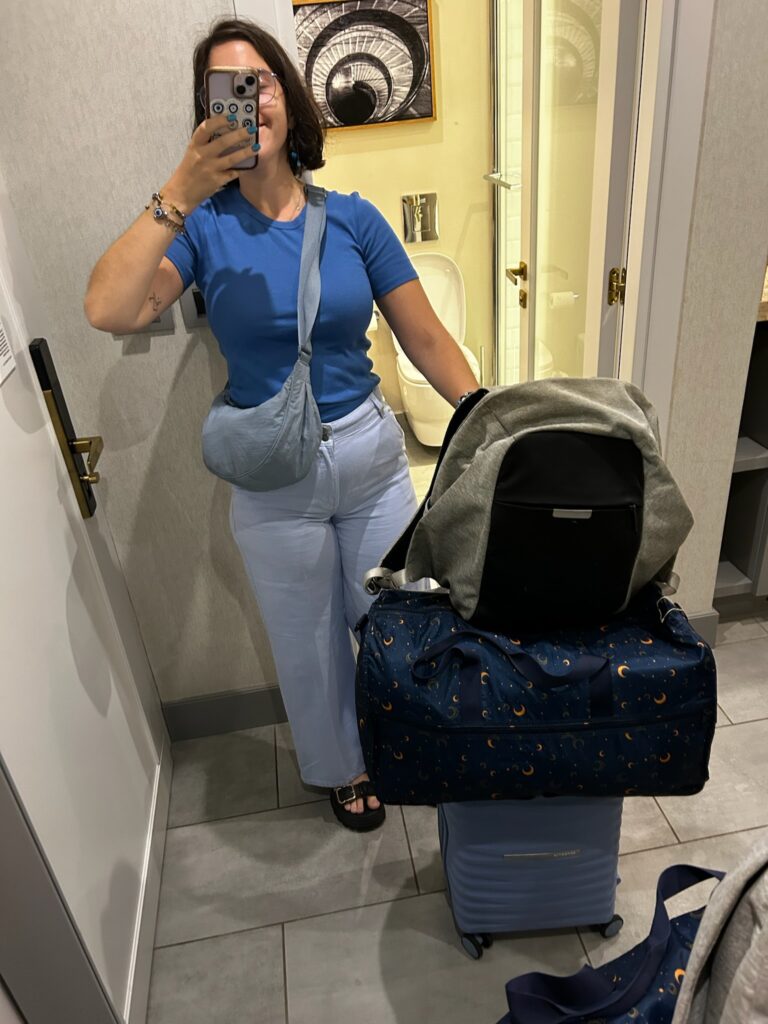

Our Actual Travel Gear: What We Bring on Every Trip
Updated April 2026 | 5 min read
Every travel gear list on the internet reads the same: ten products the author got sent for free, described with words like “game-changer” and “must-have.” This is not that. These are the actual products Jenna and I pack on every trip, purchased with our own money, tested across 15+ countries and four continents. Some of these we are on our second or third version of because we wore the first one out.
Luggage
Main Carry-On: Travelpro Maxlite 5 (21-inch Expandable Spinner)
Travelpro Maxlite 5 — $140-170 depending on color.
This is the bag flight crews use, and there is a reason for that. It weighs 5.4 pounds empty, which matters when budget airlines give you a 7kg or 10kg carry-on allowance. The soft shell means you can squeeze it into those metal sizers that European airlines love to enforce. The expandable zipper gives you an extra two inches on the way home when you have inevitably bought things.
What I wish were better: The wheels are not as smooth as premium brands. On cobblestone streets in Rome or Split, you feel every bump. But for half the price of an Away and a third of a Rimowa, the tradeoff is worth it.
Alternative we have also used: The Away Carry-On ($295) is better built with smoother wheels, but it is a hardshell, which means less flex in tight overhead bins and no expansion. The built-in battery is convenient but adds weight.
Personal Item: Calpak Luka Duffel
Calpak Luka Duffel — about $88.
Jenna found this one and it replaced our old personal item bags immediately. 25-liter capacity, structured bottom so it stands up on its own, laptop sleeve, and it slides under every airline seat we have tested including Ryanair. Weighs two pounds empty. It is not waterproof, but we have not had an issue yet.
Day Bag: Matador On-Grid Packable Daypack
Matador On-Grid Daypack — about $45.
This lives in the carry-on and comes out at the destination. It packs into its own pocket, weighs almost nothing, and has survived being stuffed to capacity at markets in Tokyo, Bali, and Seoul. We use it for day trips, grocery runs, and as a beach bag. After two years of regular use, the zippers still work and the fabric has not torn.
Packing and Organization
Packing Cubes: Peak Design Packing Cubes
Peak Design Packing Cubes — $40-50 per cube.
Expensive for packing cubes, but they do two things cheaper ones do not: genuine compression that stays compressed, and tear-away zippers that let you access the full width of the cube without unzipping completely. Made from recycled nylon, extremely durable. We have the small and medium and they fit perfectly in the Travelpro.
Budget alternative: Eagle Creek Pack-It Isolate Compression Cubes ($25-35) compress nearly as well and come in more size options.
Toiletry Bag: Gravel Explorer Plus
Gravel Explorer Plus — about $55.
This is the one toiletry bag that has actually solved the problem. The TSA-approved clear pouch detaches so you can pull it out at security without unpacking everything. The main compartment holds full-size items for the hotel, and everything has a specific pocket. We tried four different toiletry bags before this one stuck.
Tech
Power: Anker 733 Power Bank
Anker 733 Power Bank — about $80.
This is the single most useful tech item I travel with. It is a 10,000mAh portable battery AND a wall charger in one unit. Plug it into the wall, it charges itself and your devices simultaneously. Unplug it, it becomes a power bank. Two phone charges, TSA-approved, and it eliminates one device from your bag. I have owned this for three years across probably 20 trips and it has never let me down.
For laptop users: The Anker Prime 100W GaN charger charges my MacBook, phone, and watch from a single compact brick. Replaced three separate chargers.
Connectivity: Airalo eSIM
Not a physical product, but it belongs on this list because it replaced a physical product. Airalo provides eSIM data plans for 200+ countries. You install it on your phone before departure, activate when you land, and you have data immediately. No hunting for SIM card shops, no adapter trays, no worrying about losing a tiny piece of plastic.
For Europe, their Eurolink package covers 39 countries. We paid $13 for 3GB over 30 days on our Balkans trip — enough for maps, messaging, and the occasional Instagram upload. If you need more data, the 10GB plan is about $26. Either way, it is cheaper than roaming and more reliable than hunting for WiFi.
Adapter: Epicka Universal Travel Adapter
Epicka Universal Adapter — about $15.
Works in every country we have visited. Period. UK, Europe, Japan, South Korea, South Africa, New Zealand — one adapter covers all of them. It has USB-A and USB-C ports built in, so for short trips it can replace a wall charger entirely. At $15, buy two so you always have a backup.
Comfort
Neck Pillow: Trtl Pillow Plus
Trtl Pillow Plus — about $60.
I was skeptical because it looks weird. It wraps around your neck like a scarf with an internal support system. But it actually holds your head up, unlike the inflatable horseshoe pillows that let your head flop forward. I have slept on long-haul flights to Japan, Bali, and New Zealand with this thing. It works.
Ear Protection: Loop Switch 2
Loop Switch 2 — about $35.
Originally bought these for F1 races, but they have become a permanent travel item. Three noise-reduction modes mean I use the low setting on planes, medium in noisy restaurants, and full quiet at the track. They look like small earbuds, not industrial earplugs, and they come with a tiny carrying case that clips to a bag.
What We Have Stopped Bringing
Gear evolves by subtraction, not addition. Here is what got cut over the years:
- Packing folders — replaced by compression cubes. Same result, less bulk.
- Separate camera — iPhone 15 Pro does everything I need for travel photography. I sold my mirrorless.
- Multiple wall chargers — the Anker 733 and GaN charger replaced three separate plugs.
- Physical guidebooks — I relied on Lonely Planet Japan in 2019. By 2024, every recommendation was either closed or overrun.
- Travel towel — every accommodation provides towels. Even hostels. This saved real space.
The goal is not minimalism for its own sake. It is freedom — the freedom to walk through an airport in ten minutes, to take a train without wrestling a checked bag up stairs, and to never stand at a baggage carousel again. Every item on this list earns that freedom. Everything else gets left home.
For the complete packing checklist organized by category, check our ultimate carry-on packing list.
Keep Reading
- Best Travel Backpacks 2027
- Best Headphones for Travel
- My Full Travel Tech Setup
- Best Portable Chargers
Affiliate disclosure: This post contains affiliate links at no extra cost to you. SafetyWing, Skyscanner, Airalo, Booking.com, Viator.
Real costs, honest reviews, and what I’d do differently — straight to your inbox.
Plan your own trip: guides I actually use
Cards, lounges & insurance:
- Best Airport Lounges I Have Actually Used — From Changi to Istanbul
- Is Priority Pass Worth It in 2026 — My Honest Review After 15 Airports
- Best Travel Credit Cards for 2026: The Cards I Actually Use and Why
- Best Travel Insurance for 2026: What I Actually Recommend After 15 International Trips
- The Credit Card Points Strategy That Funded $15,000 of Travel
Finding cheap flights:
- Going vs Dollar Flight Club vs Thrifty Traveler: Which Flight Deal Service Is Worth It in 2026?
- When to Book Flights by Region — The Booking Windows That Actually Save Money
- How to Find Error Fares and Flight Deals — The Services I Actually Use
- Google Flights vs Skyscanner vs Momondo — Which Actually Finds the Cheapest Flights
Staying connected abroad:
- Best VPN for Travel 2026 — NordVPN vs Surfshark and Why You Need One
- Best eSIM for Travel 2026 — Holafly vs Airalo vs Nomad
Travel gear I actually use:
- Best Portable Chargers for Travel in 2026: Which Size You Actually Need
- My Exact Travel Tech Setup After 15 International Trips
- Best Noise-Canceling Headphones for Travel in 2026: Tested on 40+ Flights
- Best Travel Backpacks for 2026: The 5 I Have Actually Used
- Phone Photography Tips for Travel: How to Take Great Photos With Just Your iPhone

Written by Jenna Fattah
I have visited 25+ countries across 6 continents, attended 7 Formula 1 races, and spent 4 years writing about what actually works and what I would do differently. Every recommendation on this site comes from trips I planned and paid for myself. Read more about me