Frequently Asked Questions
What is the best month to visit the Greek Islands?
Late September through mid-October is ideal. The summer crowds thin out, water is still warm from summer, and prices drop 20-30%. Avoid July-August when ferries are packed and hotels triple in price.
How many Greek islands can you visit in a week?
Stick to 2-3 islands in a week. Santorini and Mykonos can be done as a pair in 5 days, or swap Mykonos for a quieter island like Naxos or Milos. Island-hopping ferries take 2-5 hours between islands.
Is Santorini worth the hype?
The caldera views and sunsets live up to the photos, but the crowds and prices are intense from June through August. Visit in shoulder season, stay in Oia for the views but eat in Fira where prices are lower.
Why the Greek Islands Are Next
Book hotels: Search Booking.com hotels
Milos has beaches that look like they were photoshopped, and most tourists skip it entirely for Santorini and Mykonos.
In This Post
- Why the Greek Islands Are Next
- Athens First: Two Days Before the Islands
- Santorini: Oia, Fira, and the Caldera
- Mykonos: Beaches, Little Venice, and When to Go
- The Quieter Islands: Naxos, Milos, and Paros
- Ferry Logistics
- What to Skip
- What Made This Trip Different
- Book Tours and Activities
- Gear and Guides We Recommend
- Related Reading
- Book Tours and Activities
- Find Flights to Santorini
- Frequently Asked Questions
Greece has been on the list for years and we are finally planning it seriously. After months of research, reading every Reddit thread, and talking to friends who have done the island circuit, here is the trip we are building — and the places most people get wrong. This is our pre-trip playbook, heavily informed by people who have actually been.
Here is what the research says works, what to repeat, and what to skip.
Athens First: Two Days Before the Islands
Don’t fly straight to the islands. Spend two days in Athens. The Acropolis earns its reputation. Seeing it in person — the scale of the Parthenon, the way it sits above the city — is different from photos. Go early, as in 8am when it opens, before the tour groups arrive and before the heat becomes brutal. In summer, by 10am it’s already uncomfortable and by noon it’s punishing. Bring water.
After the Acropolis, walk down into Plaka, the old neighborhood at its base. The tavernas on the outer edges — away from the main drag — are decent. Moussaka properly made: properly layered, thick bechamel that’s browned in spots, a meat filling with cinnamon and allspice in it. Order it everywhere in Greece. It varies significantly by region and cook.
Day two: the National Archaeological Museum in the morning (the Antikythera Mechanism display alone is worth the entrance fee), then Monastiraki flea market and Psiri in the afternoon — better restaurants than the tourist-facing areas of Plaka.
Where to stay: Monastiraki, walkable to everything. Budget around 80-120 euros per night for a decent mid-range hotel.
Santorini: Oia, Fira, and the Caldera
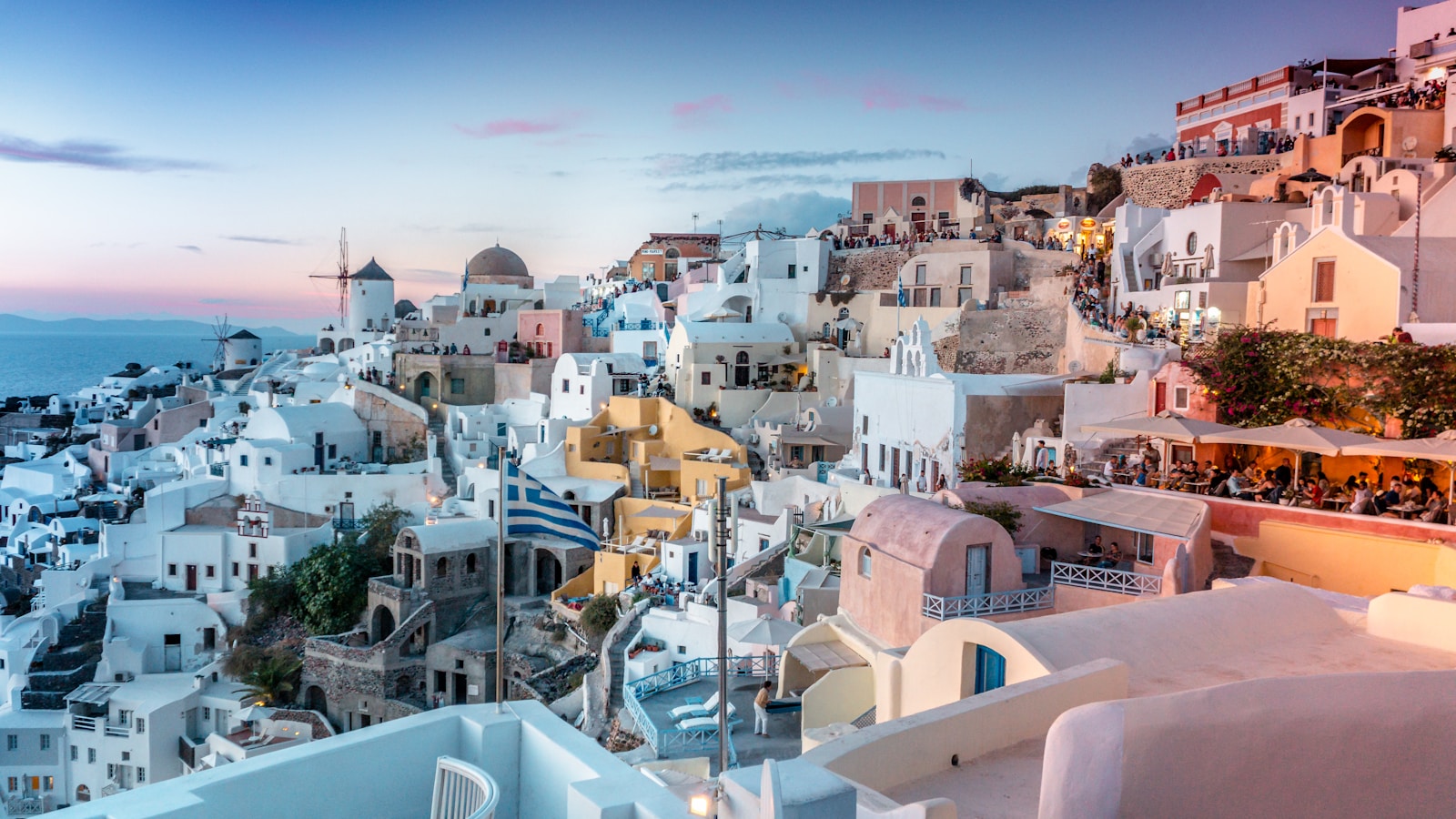
Santorini is everything people say it is, for better and worse. It’s dramatically beautiful. The caldera — the collapsed volcanic crater forming the island’s western face — creates cliffs that drop straight into deep blue water. The white cubic buildings with the blue domes are real, not a filter. And it’s also expensive, crowded in peak season, and Oia at sunset is a genuine mob scene.
Stay in Fira, the main town, not Oia. Fira is cheaper, more walkable, and has better restaurant options. Oia is prettier for photos but you’ll be jostling for space with hundreds of other people. If you want the Oia sunset, get there early, find a spot on the castle ruins, and accept the crowds. It’s still a beautiful sunset.
The caldera hike from Fira to Oia is about 10 kilometers, three to four hours. Do it in the morning. The path follows the rim of the caldera with views down to the water the entire way. Start at 7am and finish before the worst heat hits. Wear real shoes — the path is uneven and some sections are loose stone.
For food in Santorini: skip the restaurants right on the caldera edge. Walk one street back and the quality improves and the price drops. Grilled octopus dried in the sun and then grilled — not boiled and seared — with a half-carafe of Assyrtiko, the local white wine. Assyrtiko is a mineral-driven, high-acid white that works perfectly with seafood. Drink it while you’re there. It doesn’t travel well and it’s different at the source. About 22 euros for the full setup.
Mykonos: Beaches, Little Venice, and When to Go
Mykonos has a reputation as a party island and that reputation is earned but incomplete. Go in August and you’ll be surrounded by yacht people and prices that make you question your choices. Go in late May, early June, or September and you get a much more manageable version of the same island.
The beaches worth visiting: Agios Sostis is a 20-minute taxi ride from town with no facilities — no music, no beach clubs, just a long stretch of sand with a small taverna at one end. Paradise and Super Paradise are the famous party beaches — loud, crowded, expensive, but genuinely beautiful if that’s your thing. Elia is long and has a mix of beach clubs and quieter stretches.
Little Venice, the row of buildings that hang over the water on the west side of Mykonos Town, is worth an afternoon. The buildings literally extend over the sea and waves break under your feet. Go around 6pm for the light.
The old town is a maze of narrow whitewashed streets. Get lost in it deliberately. Most good small restaurants are tucked into alleys rather than on the main pedestrian streets. Fresh fish tavernas: look for places with fish displayed on ice out front — you pick what you want, they weigh it, you pay by the kilo. Expect 60-80 euros per kilo for most fish.
The Quieter Islands: Naxos, Milos, and Paros
This is where Greece becomes a different kind of trip. These islands have things Santorini and Mykonos have largely lost: local life, reasonable prices, and the feeling that tourism hasn’t completely taken over.
Naxos is the largest of the Cyclades and the most self-sufficient — it produces its own food, wine, and marble. The old town has a Venetian castle on a hill with people actually living inside the castle walls. Beaches that rival anything in Santorini: Agios Prokopios and Plaka are long, wide, and backed by dunes rather than cliffs. The local cheese, graviera, is excellent and cheap. A full day of eating and drinking in Naxos Town costs less than a single caldera-view cocktail in Oia.
Milos has the most dramatic geology outside Santorini. Sarakiniko is a lunar landscape of white volcanic rock with small sandy pockets between formations. Kleftiko, accessible only by boat, has sea caves and turquoise water. Rent a boat for a day — the island’s best spots are unreachable by road.
Paros sits between Mykonos and Naxos in character as well as geography. Naoussa, the fishing village on the north coast, is genuinely charming — small harbor, good fish restaurants, the quieter Cycladic aesthetic without the crowds.
Ferry Logistics
Book through Ferryhopper or directly on the ferry company websites (Blue Star Ferries, SeaJets, Hellenic Seaways). Book a few weeks ahead in peak season for high-speed routes involving Mykonos or Santorini.
High-speed ferries are more expensive but much faster — Athens to Santorini is about 5 hours high-speed versus 8-9 hours conventional. Take the conventional ferry at least once for the experience, but if you’re island hopping efficiently, the fast ferries save real time.
The Athens port is Piraeus. Take the metro from the city center (Line 1, green line, 45 minutes) rather than a taxi.
What to Skip
The Oia sunset as a primary goal. Watch it from Fira or from a boat instead.
All-inclusive resort dining. Greece has good food at reasonable prices in local tavernas. The best meals will cost 14-22 euros at a family-run place. There’s nothing a resort restaurant can do that justifies skipping the local options.
Party Mykonos in August if you’re not there specifically for that. The island has enough to offer outside the beach club circuit that you don’t need to participate in it.
What Made This Trip Different
- Greece has more islands than most people realize — officially over 6,000, of which 227 are inhabited. The ones most people visit represent a tiny fraction.
- The meltemi wind blows hard from the north in July and August across the Cyclades. It keeps temperatures bearable but can ground ferries and makes north-facing beaches rough for swimming.
- Greek coffee — ellinikos kafes — is made the same way as Turkish coffee, brewed in a small copper pot. Order sketos (no sugar), metrios (medium sweet), or glykos (sweet). Don’t drink the grounds at the bottom.
- Greece is on Eastern European Time, two hours ahead of the UK and seven hours ahead of the US East Coast. The late dinner culture is real — restaurants don’t fill up until 9pm and locals often eat at 10 or 11.
- Learning to read the Greek alphabet phonetically takes about two hours and makes navigation significantly easier — you can sound out street signs and menus even without understanding the words.
Book Tours and Activities
- Santorini catamaran cruises on Viator — the sunset caldera cruise is the single best thing to do
- Athens skip-the-line Acropolis tours — essential in summer
- Top-rated Greece activities on TripAdvisor
Gear and Guides We Recommend
- Universal Travel Adapter — Greece uses Type C and F plugs, standard European.
- Comfortable Walking Sandals — Cobblestones in Plaka, Mykonos Town, and every other old quarter will destroy cheap sandals.
- Rick Steves Greece Guide — Thorough and practical. Honest about which sites are worth the entrance fee and which aren’t.
Related Reading
- Italy by Train: What to See and How to Move Between Cities
- Capri and the Amalfi Coast: What’s Worth It and What to Skip
- Balkans Road Trip: Dubrovnik, Split, and Beyond
- How We Plan Our Trips: Tools, Timelines, and What We Book in Advance
- Credit Card Points for Travel: How We Pay for Most of Our Flights
Book Tours and Activities
Find Flights to Santorini
Cheapest Flights to Santorini
| Departure at | Return at | Stops | Airline | Find tickets |
|---|---|---|---|---|
| 25 May 2026 | 30 May 2026 | Direct |  |
Tickets from 1 021 |
eSIM: Get an Airalo eSIM for Greece before you land. Data works immediately, no hunting for local SIM cards.
Book Tours: GetYourGuide skip-the-line tickets and sailing tours in Santorini | GetYourGuide Mykonos boat trips and island-hopping tours
Tours: Santorini tours on Viator
Travel Insurance: We use SafetyWing for travel insurance on every international trip. It covers medical emergencies, trip interruptions, and lost luggage starting at $45/month with no fixed end date — perfect for multi-country itineraries.
Get Travel Tips That Actually Help
Real costs, honest reviews, and what I’d do differently — delivered to your inbox.
No spam. Unsubscribe anytime.
Written by Jenna Fattah
I have visited 25+ countries across 6 continents, attended 7 Formula 1 races, and spent 4 years writing about what actually works and what I would do differently. Every recommendation on this site comes from trips I planned and paid for myself. Read more about me